Getting rid of garden waste in North London
A hedge cut or a weekend’s pruning can leave more green waste than the bin will take. Here are the ways to get rid of it in North London, what the councils offer, and when it is easier to pay someone to take it away.
 Knights GardensAbout 5 minutes’ read

The options at a glance
- A council garden waste collection, which you subscribe to, for everyday amounts.
- A reuse and recycling centre, if you have a car or a way to carry it.
- Composting at home, for leaves, grass and soft prunings.
- A waste removal or clearance from a registered carrier, for a big pile, hedge cuttings, or a garden that needs cutting back first.
Council garden waste collections
Each of the five councils that cover most of our area runs a garden waste collection that households sign up to. The details, including the list of what is accepted, how often collections run and the charge, are on each council’s own page, and they change, so check before you subscribe:
The North London Waste Authority says the boroughs offer these collections and that some charge for them, with a bin or bags depending on the borough. If you live near a borough boundary, check which council collects your street.

Reuse and recycling centres
You can also take garden waste to a reuse and recycling centre. The North London Waste Authority lists these centres in the boroughs above: Western Road (Haringey, N22), Summers Lane (Barnet, N12), Barrowell Green (Enfield, N21) and Edmonton EcoPark (Enfield, N18), Regis Road (Camden, NW5) and Hornsey Street (Islington, N7). Islington says residents can take garden waste to its Household Reuse and Recycling Centre for free, with a pedestrian drop-off point at the Hornsey Street entrance. Each site has its own page on the NLWA website, so check what you need to bring and whether vans are allowed before you go.
What counts as garden waste
The NLWA says grass cuttings, leaves, hedge clippings and small branches can be recycled as garden waste. Broken garden furniture and tools should not go in, because their wood may be contaminated with chemicals or other materials. Soil, rubble, turf and plant pots are often excluded from the bin, so check your council’s list; a clearance often produces some of each. Mixed loads need splitting, which is why a big job is easier to hand to someone with a vehicle.
Compost it
The NLWA also promotes home composting as a way to cut the environmental impact of your garden waste. Grass, leaves and soft prunings suit a compost bin, and leaves can be turned into leafmould; see our guide to winter garden jobs and leaf clearance for how.
Don’t burn it
There is no blanket ban on garden bonfires, but GOV.UK says councils must look into complaints about smoke and fumes that could be a statutory nuisance, and can serve an abatement notice. You can be fined if the smoke drifts across a road and endangers traffic, and you must not get rid of household waste in a way that causes pollution or harms health, which includes burning it. GOV.UK suggests composting or recycling instead.

When to pay for a removal or a clearance
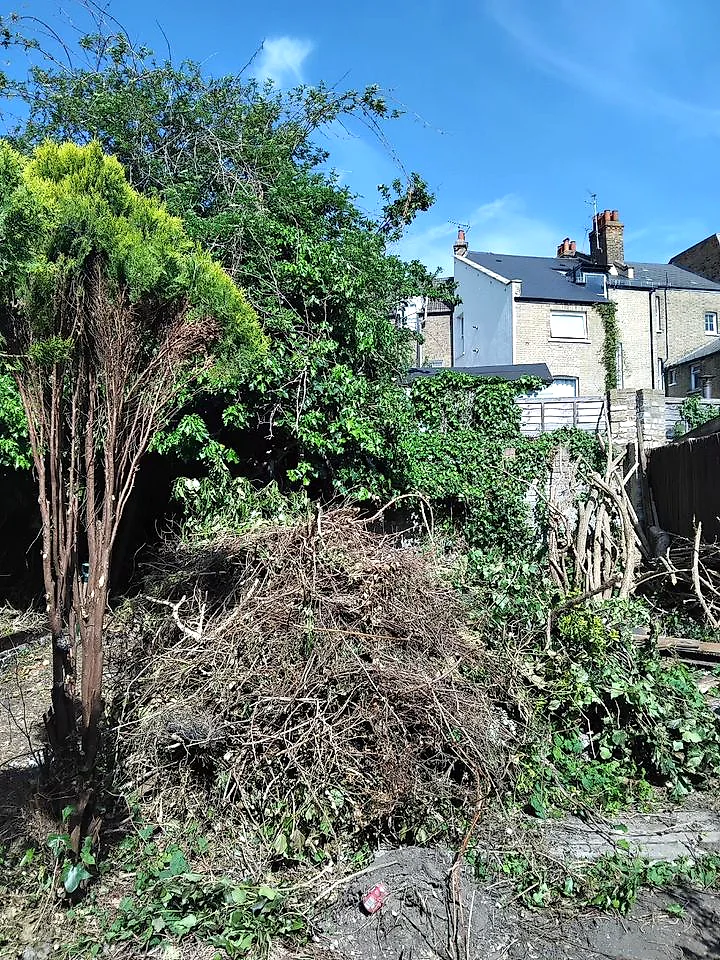
Council collections suit everyday amounts. For a bigger pile, the cuttings from a hedge cut, or waste that has built up over a few seasons, it is quicker to have it collected. Tell us how much there is, where it is, and how it gets out: many Victorian properties have no side passage, so bags and cuttings go through the property. A photo with something in the picture for scale is the easiest way to show the amount. See garden rubbish removal, or garden clearance if the garden needs cutting back first; our guide to what happens on a garden clearance explains the steps.
Whoever takes your waste, check them. The Environment Agency suggests searching its public register of waste carriers, brokers and dealers for a valid registration, asking where the waste is going, and getting a receipt. Cash-only offers are a warning sign. We look after gardens in Muswell Hill, Camden Town and Palmers Green, among many other parts of North London.