Removing ivy from walls, fences and trees safely
Ivy gets the blame for a lot of damage that it does not cause, and pulling it off carelessly can do more harm than leaving it. Here is when ivy is a problem, how to take it off a wall, fence or tree, and what to check before you start.
 Knights GardensAbout 6 minutes’ read

Does ivy damage walls?
Usually not, says the RHS. Ivy’s aerial roots are unable to bore into sound masonry, but they can enlarge cracks and joints that are already there, and they can lift roof tiles. Historic England’s guidance makes the same point from the other side: what ivy does to a wall depends on the condition of the wall underneath.
The bigger risk is often removal. The RHS warns that taking ivy off can pull away paint and loose mortar, and you may need to fill cracks and joints, re-render or repaint afterwards. Its advice is to remove a small section carefully first, as a test, to see what condition the wall is left in before you decide whether to carry on.
When removal is worth it
- Loose mortar, cracks or failing render. If ivy is growing into them, take it off carefully, and expect repairs.
- Gutters and roofs. Ivy can grow into gutters and lift roof tiles, so keep it trimmed away from them.
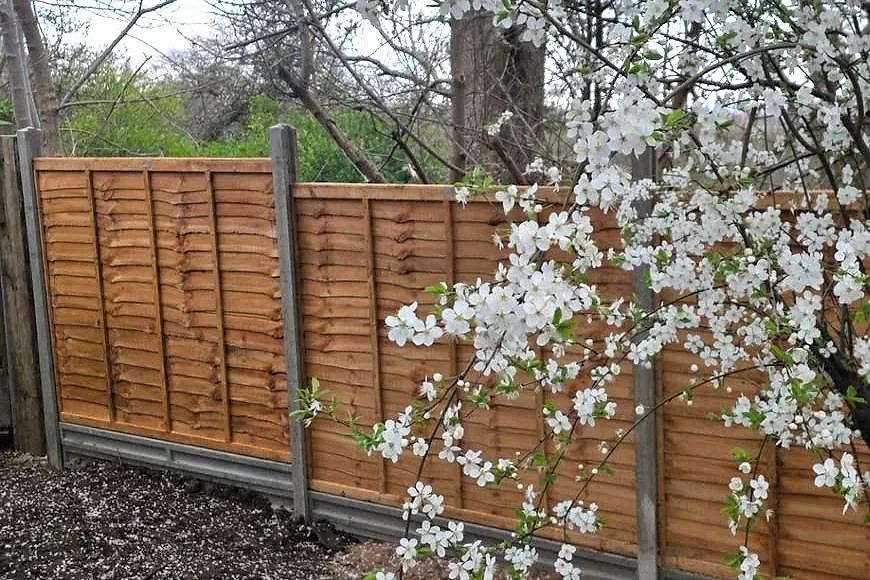
- Fences. The RHS says stems can damage a wooden fence by growing into the gaps between slats or panels, and thickening stems can push sections apart. See our guide to fencing if the fence itself has to be renewed.
- Weak or ornamental trees. More on this below.

Before you start
- Nesting birds. The RHS says to check for nests before starting. Ivy is a favourite nesting place, and damaging an active or under-construction nest is an offence under the Wildlife and Countryside Act 1981. Cutting in spring or summer needs a careful look first.
- Skin. Contact with ivy can irritate the skin, so wear gloves and cover your arms and legs. It is harmful if eaten, by people or pets.
- Waste. Cut ivy is bulky. See our guide to getting rid of garden waste.
How to take ivy off a wall or fence
- With secateurs or loppers, cut and peel the outermost stems away first, then work inwards.
- Saw the thicker central stems out in pieces. Don’t pull large sections off in one go, because that can damage what is underneath.
- Leave the main stems attached to their roots until the end. The RHS says cutting them early increases the chance of the plant rooting in to the wall higher up.
- Dig out the stump and as many large roots as you can, to stop regrowth.
- Remove leftover root hairs with a wire brush, a metal wallpaper scraper or a pressure washer, taking care not to damage paint or mortar.
- If you can’t dig the stump out, cut new growth back to ground level regularly. It will weaken the plant, but the RHS says it may take a long time to kill it.
Ivy on trees
The RHS says ivy’s aerial roots don’t penetrate tree bark, and a healthy mature tree can usually cope with the competition for water, nutrients and light. It suggests removing ivy from ornamental trees with decorative bark such as birches and acers, from young or newly planted trees, from trees with sparse canopies such as ash and larch, and from old, weak or damaged trees, where ivy can hide decay or cavities.
To do it, cut all the stems near ground level with loppers, a pruning saw or a chainsaw. That kills the growth above, although dead leaves often stay attached. Dig out the stump if you can. On large trees the stems often can’t be pulled off, so the RHS suggests leaving them in place. Ivy’s weight can also make a weakened canopy unstable in wind, so for an ailing tree it advises getting advice from a tree consultant. Our guide to tree work and council consent covers what to check if the tree itself may be protected, and we also take on tree surgery.
Keeping ivy under control instead
If the wall or fence is sound, the alternative is not to remove it at all. The RHS says pruning once a year is often enough, though a vigorous plant may need several trims, and that ivy should be kept out of gutters and away from the gaps in fences. It also notes the wildlife value: ivy gives shelter, nesting sites, late nectar and pollen, and berries for birds. Check for nests before you cut it back, whatever the month.
When to ask for help
A wall covered to the roofline, a tree you can’t reach from the ground, or a garden where ivy is only one of the problems are all jobs to hand over. We strip ivy back and remove unwanted shrubs and small trees as part of garden clearance, and take the waste away; our guide to what happens on a garden clearance explains how to prepare. We look after gardens in Muswell Hill, Crouch End and Finsbury Park, among many other parts of North London.